
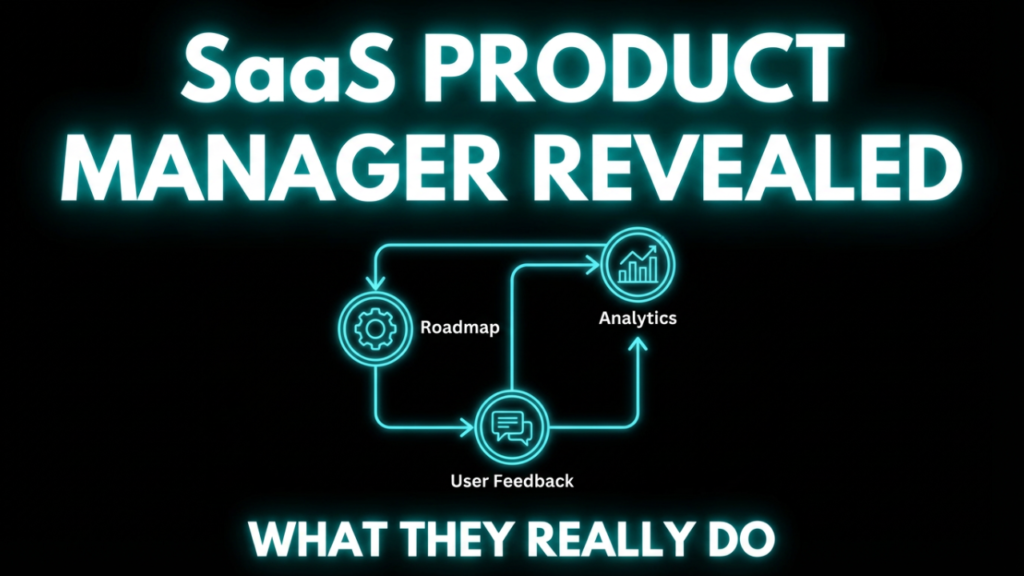
Master SaaS product manager roles—daily tasks, essential skills, salary ranges, and the proven roadmap to break into product management in 2026.
KEY TAKEAWAYS
SaaS product manager roles blend strategy, analytics, and cross-team leadership to drive subscription software growth. You’ll prioritize features using data like MRR and churn, align engineering with business goals, and ship products users pay for monthly. Salaries range ₹8-40 lakhs in India, with global remote roles paying $70K-$190K in 2026.
SaaS Product Manager Roles Explained: 7 Skills That Actually Matter in 2026
You’re staring at a “SaaS product manager” job listing wondering: what do these people actually do?
Here’s the truth. SaaS product manager roles aren’t about endless meetings or fluffy vision statements. You’re the bridge between customers demanding features, engineers needing clear specs, and executives obsessing over monthly recurring revenue.
In subscription software, bad decisions cost you customers every month. Miss a competitor’s launch? Users churn. Ignore onboarding friction? Activation tanks.
This guide shows you what SaaS product managers actually do, the skills that matter, and how to land these roles—even without prior PM experience.
What Does a SaaS Product Manager Do Daily?
Let me walk you through a real Tuesday—no fluff.
Morning (8 AM – 12 PM): You check overnight analytics in Amplitude. Activation dropped 4% last week. Dig into session recordings via LogRocket. Spot a bug in email verification. Slack engineering. Create a Jira ticket. Prioritize against three other bugs based on MRR impact.
Join a customer call. A SaaS product manager listens more than talks. Enterprise client wants SSO integration—seventh request this quarter. Time to bump it on the roadmap.
Afternoon (1 PM – 5 PM): Stand-up with engineering. One dev’s blocked on API docs. Connect them with solutions architect. Review Figma mockups for new onboarding. Designer used a carousel—you suggest tooltips based on Pendo data showing users skip carousels.
Write acceptance criteria for next sprint. Update the SaaS product roadmap in Productboard. Field sales questions about mobile app launch dates.
Evening (5 PM – 6 PM): Prep tomorrow’s stakeholder sync. Export churn metrics. Draft a one-pager explaining why you’re killing that feature only 2% of users touched.
SaaS product manager roles live at the intersection of data, code, and human behavior. If you’re not comfortable saying “no” backed by metrics, reconsider.
How Much Does a SaaS Product Manager Earn in 2026?
Let’s talk numbers.
India market:
- Junior SaaS product manager: ₹8-15 lakhs/year
- Mid-level (3-5 years): ₹18-28 lakhs/year
- Senior/Lead: ₹30-40 lakhs/year
- Director of Product: ₹50+ lakhs/year
Global remote roles (USD):
- Associate PM: $70K-$95K
- Product Manager: $110K-$145K
- Senior PM: $150K-$190K
Equity sweetens deals. SaaS product manager roles at funded startups often include 0.1%-0.5% stock options. Bangalore-based Series B companies now compete with Silicon Valley salaries.
Domain expertise in fintech or dev tools adds a 20-30% premium. B2B SaaS product manager roles pay more than B2C.
7 Essential Skills for SaaS Product Manager Roles
1. SaaS Metrics Fluency
You need to explain why CAC payback matters more than total signups.
Core metrics:
- MRR/ARR (Monthly/Annual Recurring Revenue)
- Churn rate (logo vs. revenue)
- CAC (Customer Acquisition Cost) and LTV (Lifetime Value)
- Activation rate (time to first value)
- Net Revenue Retention (NRR)
- Net Promoter Score (NPS)
Use Mixpanel or Amplitude to build dashboards showing these KPIs weekly.
2. Technical Depth Without the Degree
Can you read API docs? Understand rate limits? Explain webhooks to sales?
Practical technical skills:
- SQL for querying databases (find power users, analyze adoption)
- REST APIs, webhooks, OAuth basics
- Cloud infrastructure costs (AWS, Azure) for build vs. buy decisions
- Git basics to review pull requests
Most SaaS product manager roles expect technical requirement docs. If “JSON payload” sounds like gibberish, start learning.
3. Customer Research Beyond Surveys
SaaS product managers prove customer obsession with behavioral data.
Research methods:
- Jobs-to-be-Done interviews
- Cohort analysis combined with usage analytics
- Session recordings for UX friction
- NPS follow-ups with churned users
- Feature requests weighted by customer ARR
Use UserTesting for remote sessions. Real insights? Join sales calls, read support tickets, use competitor products yourself.
4. Ruthless Prioritization
Your backlog has 200 requests. You ship maybe 10 this quarter.
Frameworks:
- RICE scoring (Reach × Impact × Confidence ÷ Effort)
- Value vs. Complexity matrix
- Kano model (delighters vs. must-haves)
Tie every feature to measurable outcomes. “Improve onboarding” is vague. “Increase Day 7 activation from 32% to 45% by reducing steps from 6 to 3” gives clarity.
5. Influence Without Authority
You don’t manage engineering, design, or sales. Yet you need them executing your roadmap.
Tactics:
- Share customer pain in story format
- Frame requests around team goals
- Create Figma prototypes before asking engineers to build
- Celebrate wins publicly, own failures privately
SaaS product manager roles fail when you rely on hierarchy instead of trust.
6. Strategic Thinking
Early-stage SaaS product managers find product-market fit. Growth-stage PMs defend it.
Questions you’ll answer:
- Which segment has highest NRR?
- What’s our defensible moat?
- Should we go upmarket or downmarket?
- When do we say “no” to dilute core value?
Read competitor changelogs weekly. Monitor G2 reviews. Track win/loss from sales.
7. Agile Execution
Frameworks don’t matter. Shipping valuable software consistently does.
What you actually do:
- Write user stories with clear acceptance criteria
- Run sprint planning and grooming
- Conduct sprint reviews with live demos
- Make trade-off decisions mid-sprint
- Track velocity for release forecasts
You’re the anchor keeping teams focused.
How to Become a SaaS Product Manager With No Experience
Most job descriptions want 3-5 years PM experience. The side-door strategy:
Step 1: Build domain expertise
Pick a vertical (martech, fintech). Use 10-15 products. Write comparisons. Identify gaps.
Step 2: Document a case study
Choose a SaaS product you use. Write a PRD for a missing feature. Include research, wireframes, metrics. Host on Notion.
Step 3: Transition from adjacent roles
- From engineering: Lead a feature end-to-end
- From design: Own entire user flows, talk to customers
- From customer success: Build business cases for top 10 requests
Step 4: Get certified strategically
Product School and Reforge offer SaaS programs (₹50K-₹150K). Certifications plus portfolio work help.
Step 5: Target smaller startups
Series A companies (20-50 employees) hire Associate PMs. After 18 months, jump to bigger firms with “SaaS PM” on resume.
SaaS Product Manager vs. Traditional PM

| Dimension | SaaS PM | Traditional PM |
|---|---|---|
| Release Cycle | Weekly/daily deployment | Months between versions |
| Revenue Model | Subscription (MRR/ARR) | One-time purchases |
| Feedback Loop | Real-time analytics | Surveys, focus groups |
| Churn Impact | Lost revenue monthly | Lower immediate impact |
| Pricing | Tiered, freemium, usage-based | Fixed, negotiated deals |
SaaS product manager roles live or die by retention. Traditional PMs can survive buggy releases fixed months later. In SaaS? Users cancel tomorrow.
Essential Tools for SaaS Product Managers
Roadmapping:
- Productboard (productboard.com): Visual roadmaps prioritized by feedback
- Aha! (aha.io): End-to-end PM suite with scoring
- Jira Product Discovery (jira.com/discovery): Agile team integration
Analytics:
- Amplitude (amplitude.com): Behavioral tracking and retention funnels
- Mixpanel (mixpanel.com): Event-based tracking for activation
- Pendo (pendo.io): In-app analytics and feedback
Collaboration:
- Notion (notion.so): Roadmaps, specs, wikis
- Linear (linear.app): Fast issue tracking
- Figma (figma.com): Design collaboration
- Loom (loom.com): Async video updates
My stack: Productboard for roadmaps, Amplitude for analytics, Linear for sprints, Loom for updates.
How to Prepare for SaaS Product Manager Interviews
Behavioral Questions (40%)
Use STAR framework:
- Situation (context)
- Task (your responsibility)
- Action (what you did with metrics)
- Result (quantified outcome)
Mention specific tools (Jira, Mixpanel, Productboard).
Product Cases (30%)
Example: “Reduce churn for B2B project management tool.”
Structure:
- Clarify: Current churn? Which segment?
- Root causes: Analyze tickets, surveys, usage data
- Solutions: Improve onboarding, add integrations, build dashboard
- Prioritize: Use RICE scoring
- Metrics: Target 15% reduction in 30-day churn
Technical Questions (20%)
Understand trade-offs. “SQL gives ACID guarantees for transactions, NoSQL scales better for event tracking.”
Metrics Questions (10%)
Know formulas. LTV/CAC ratio should be 3:1+. CAC payback under 12 months is ideal.
Critical KPIs for SaaS Product Managers
Acquisition:
- CAC, activation rate, trial-to-paid conversion
Engagement:
- DAU/MAU ratio, feature adoption, session frequency
Retention:
- Logo churn, revenue churn, NRR
Revenue:
- MRR/ARR, ARPU, LTV
Product Health:
- Time to value, NPS, support tickets
Build dashboards in Amplitude. Update weekly. Make them public company-wide.
Is SaaS Product Management Worth It?
Pros: High demand—India’s SaaS crossed $30B in 2025. Skills transfer across industries. Fast feedback loops.
Cons: Always-on pressure. Revenue treadmill exhausts. Data overload drowns you. Political minefields between sales, engineering, execs.
Worth it if you love solving puzzles with data and shipping software thousands use monthly.
Can Engineers Transition to SaaS Product Manager Roles?
Absolutely. Your advantages:
- Understand technical trade-offs
- Review code and architecture
- Earn dev team respect
- Make informed build vs. buy decisions
Skills to develop: business acumen, customer empathy, prioritization, stakeholder management.
Transition tactics:
- Lead a feature end-to-end in current role
- Volunteer for product planning
- Shadow your PM for a week
- Build side projects as real products
- Network with PMs internally
Your 5-Step Implementation Roadmap
Weeks 1-4: Study 5 SaaS products. Read “Inspired” by Cagan. Complete free PM course. Set up Mixpanel, Notion, Figma accounts.
Weeks 5-8: Write PRD for missing feature. Document competitor analysis. Host on Notion portfolio.
Weeks 9-16: Lead small project at work. Join r/ProductManagement. Find mentor via ADPList. Consider certification.
Weeks 17-20: Apply to Associate PM roles at Series A/B startups. Network with PMs on LinkedIn. Try contract PM work.
Weeks 21-24: Practice case studies with peers. Prepare STAR stories. Study company products. Follow up with additional ideas.
Most transitions take 6-12 months. Every week compounds.
Your Challenge
Pick one SaaS product you use daily. Identify three frustrating experiences. For each, write:
- Why it matters (user impact)
- How you’d fix it (solution)
- How you’d measure success (metric)
Post your analysis in comments. Send it to the company’s PM on LinkedIn. That conversation could be your first step.
The SaaS product manager roles are out there. The demand is real. What’s stopping you?